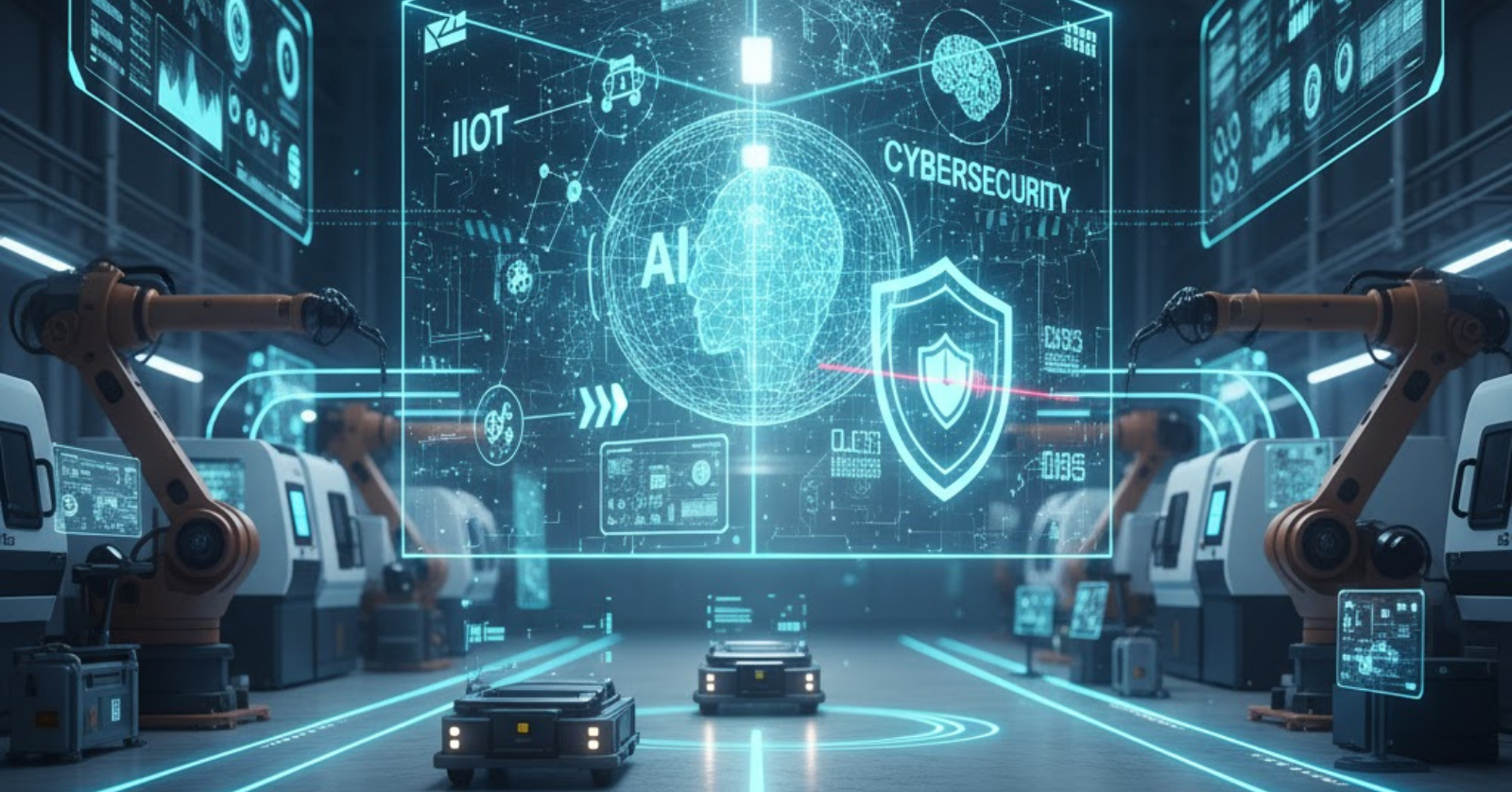
In the era of Industry 4.0, the factories of tomorrow are no longer mere mechanized production lines — they are intelligent, interconnected ecosystems. At the heart of this transformation lies a powerful triad: Artificial Intelligence (AI), Industrial Internet of Things (IIoT), and Cybersecurity. Together, they form the backbone of future factories — facilities that are more efficient, agile, resilient, safe, and scalable.
Let’s unpack how each pillar reinforces the others and why their intersection is absolutely critical.
1. The Role of IIoT: The Nervous System of Modern Factories
IIoT refers to networks of industrial sensors, actuators, machines, and control systems that communicate and exchange data, often in real time. These embedded devices capture metrics like temperature, vibration, throughput rates, energy consumption, and more, creating a continuous stream of operational data.
• IIoT systems enable real time visibility and monitoring across the factory floor, enabling predictive maintenance, anomaly alerts, and process optimization.
• They act as gateways for edge computing and decentralized decision making, reducing latency, and allowing responsiveness at point of use.
• By tying together production lines, supply chain systems, and logistics, IIoT breaks down silos and allows factories to adapt to changing demand or constraints.
However, IIoT’s great strength — extreme connectivity — also becomes a vulnerability if left unsecured.
2. AI: The Intelligence That Transforms Data into Action
Raw data from IIoT devices is only as good as the insights drawn from it. That’s where AI steps in.
• Predictive maintenance: Machine learning models detect patterns in vibration, temperature, or energy usage to predict equipment failure before breakdowns occur.
• Quality control and inspection: Computer vision systems can catch defects on production lines faster and more consistently than human eyes.
• Adaptive process optimization: AI algorithms continuously optimize parameters (speed, feed, temperature, timing) to maximize yield, minimize energy usage, or reduce waste.
• Autonomous orchestration: In advanced settings, AI can coordinate multiple production modules, balancing throughput, scheduling, buffer zones, and resource allocation.
As McKinsey notes, AI remains one of the fastest growing vectors in enterprise tech, with increased focus on autonomy, agentic AI, and application specific solutions. Meanwhile, automation firms are pushing deeper integration of AI and IIoT to realize “smart factories.”
Yet, applying AI in industrial settings demands trust, integrity, and security, which brings us to the third pillar.
3. Cybersecurity: The Guardian of Trust and Continuity
In a hyperconnected factory, every sensor, controller, and network link becomes an attack surface. Threats are no longer theoretical — they’re real, persistent, and evolving.
Key challenges & threats:
• IT/OT convergence risks: Traditional information technology (IT) and operational technology (OT) are merging. This convergence expands attack vectors between enterprise networks and floor-level control systems.
• Ransomware and extortion attacks: Attackers may lock down manufacturing systems, causing significant downtime and financial losses.
• Supply chain attacks & firmware backdoors: Compromised components or malicious firmware inserted by upstream vendors can infiltrate systems.
• Data integrity attacks: Altering sensor data or control commands can lead to equipment damage or unsafe operations.
• Insider threats & misconfigurations: Human error or privileged misuse can create vulnerabilities.
In 2025, the industrial cybersecurity market is under increasing pressure to balance proactive security investment and operational resilience. Meanwhile, new security strategies are emerging: edge security, zero trust models, AI driven defense, blockchain for data integrity.
4. Why the Triad Must Work in Concert
The magic of future factories lies not in each pillar alone, but in their synergy
• Visibility + intelligence + resilience: IIoT gives you the “what’s happening,” AI tells you “what could happen / how to act,” and cybersecurity ensures you can trust those signals and act safely.
• Closed‐loop automation: AI may trigger control actions (e.g. adjust turbine speed or divert flow) — but that control path must be secure to prevent hijacking or sabotage.
• Resilient autonomy: In autonomous or semi autonomous production zones, security becomes a gatekeeper — only verified agents, commands, or data can influence processes.
• Regulatory, safety, and compliance alignment: Many industries (e.g. automotive, pharma, aerospace) demand audit trails, traceability, and fault tolerance. Cybersecurity ensures that logs, configurations, and data integrity are enforced.
• Trust with stakeholders: Customers, regulators, and partners need assurance that the “smart factory” is not a weak link. Demonstrable security posture builds confidence.
A factory that has AI and IIoT but is insecure is brittle; one that is secure and instrumented but lacks intelligence is under leveraged.
5. Deployment Principles & Best Practices
To make the triad work in real settings, observe these guidelines.
1. Start with segmentation & zero trust
Divide network domains (OT, IIoT edge, enterprise) with firewalls, microsegmentation, and ensure every access requires verification.
2. Embed security from the design (shift left)
When developing sensors, gateways, AI agents, build in encryption, authentication, firmware signing, secure boot, and update mechanisms.
3. Hybrid compute architecture (edge + cloud)
Run latency-sensitive AI models at the edge, but aggregate learning in cloud or hybrid setups — balancing performance, bandwidth, and security.
4. Continuous learning & anomaly detection
Models should evolve to detect zero-day anomalies or attack vectors; use unsupervised or self learning models for detection.
5. Audit trails, logging, and explainability
Maintain immutable audit logs (potentially blockchain backed), explain AI decisions in critical settings, and enforce traceability.
6. Redundancy, fallback, and human override
In mission critical systems, always have fallback modes, safe states, and human intervention paths.
7. Training, culture, and governance
Equip staff with cyber hygiene, incident response drills, and define clear responsibility matrices.
8. Pilot projects and phased scaling
Start with non critical cells or modules, mature capabilities, then scale across the plant.
6. Future Outlook & Challenges
• Scalability vs. energy constraints: AI and IIoT compute demands may strain power budgets; efficient models and edge innovations are more vital than ever.
• Talent shortage & organizational friction: Many manufacturers cite cybersecurity readiness and workforce upskilling as top challenges.
• Regulation and standards: More regulations (e.g. industrial cybersecurity norms, data sovereignty laws) will push factories to embed compliance from day one.
• Adversarial AI & model attacks: As AI becomes common in defense and operations, adversarial techniques (poisoning, evasion) will also increase.
• Interoperability and legacy systems: Many factories operate with legacy machines; integrating them securely into modern IIoT/AI frameworks is tricky.
Yet, for those who get the triad right, the rewards are significant: higher throughput, reduced downtime, predictive resilience, agile adaptability, lower risk, and strategic advantage.
Future factories are not fanciful visions — they’re emerging realities, powered by the triad of IIoT, AI, and cybersecurity. But none can thrive in isolation. IIoT provides the sensory layer, AI delivers actionable intelligence, and cybersecurity ensures trust, integrity, and resilience.