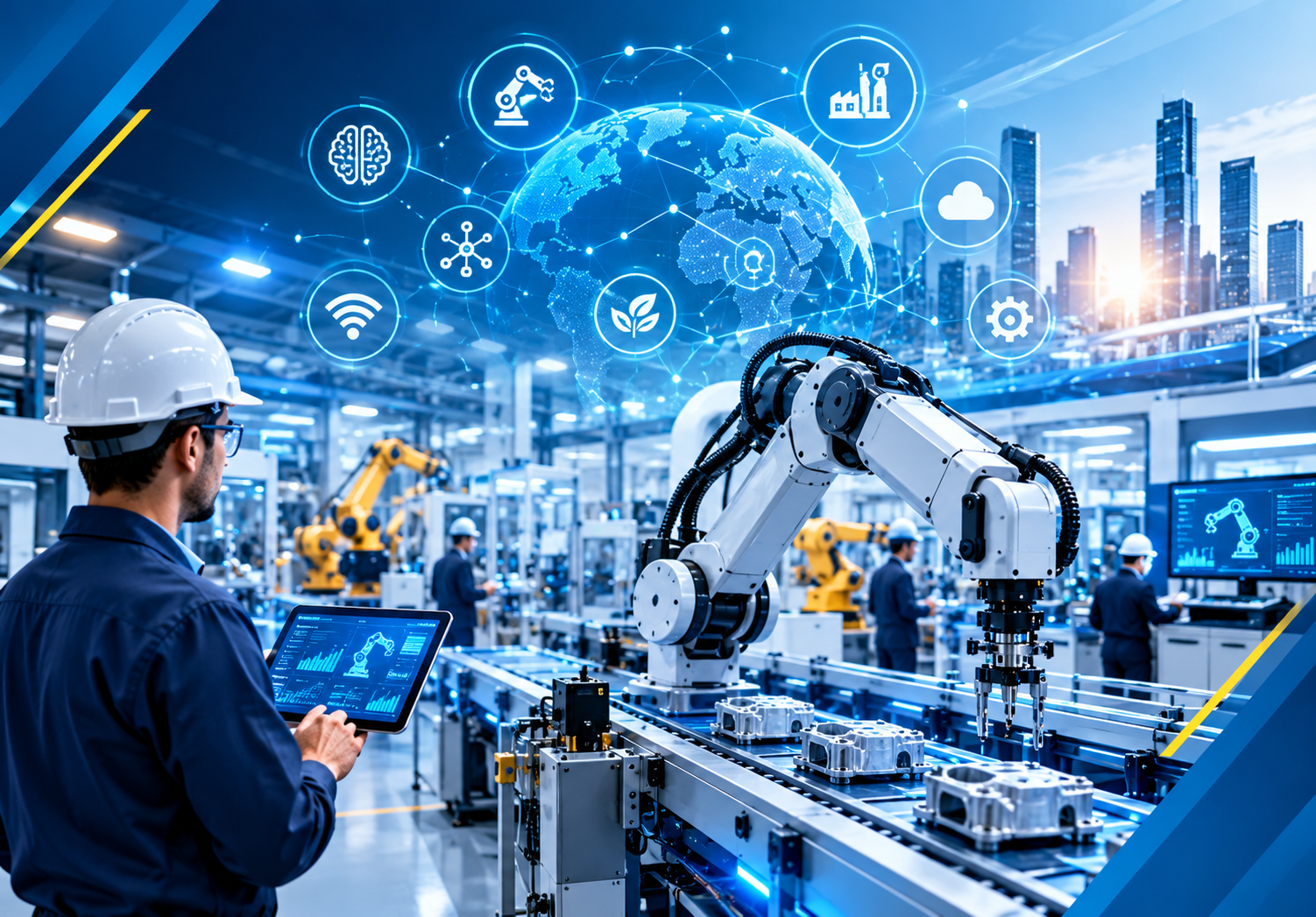
The next industrial revolution is not being driven by a
single technology. It is being shaped by the convergence of Artificial
Intelligence (AI), industrial robotics, Industrial Internet of Things (IIoT),
machine vision, digital transformation, smart manufacturing and increasingly
autonomous systems.
Manufacturing is moving beyond traditional automation.
Machines are no longer simply following predefined instructions. With real-time
data, connected systems and AI-powered intelligence, industrial environments
are becoming more adaptive, predictive and capable of making increasingly
complex decisions.
This transformation will be at the centre of Automation
Expo 2027, taking place from 2–5 June 2027 at Halls 2, 3, 4 & 6,
Bombay Exhibition Centre (BEC), Goregaon, Mumbai. The 20th edition will
bring together industrial automation, robotics, AI, IIoT and smart
manufacturing technologies on one platform.
The Shift from Automation to Autonomy
For decades, industrial automation has focused on making
repetitive processes faster, safer and more consistent. The next phase is about
creating systems that can sense, analyse, respond and adapt.
This is where technologies such as AI, industrial data
platforms, connected machines and autonomous systems become increasingly
important.
Automation Expo 2027 captures this transition through its
theme, “Agentic AI & Hyper-Autonomous Ecosystems.” The theme focuses
on how AI-enabled systems can move beyond simply analysing information and
begin reasoning, acting, adapting and continuously optimising industrial
operations.
The result is a new vision of the factory—one where
machines, software, sensors and enterprise systems work together as an
interconnected ecosystem.
Artificial Intelligence Is Changing Industrial
Decision-Making
AI is becoming an important part of modern manufacturing
because industrial environments generate enormous amounts of data.
Production equipment, sensors, quality systems and connected
devices continuously generate information. AI and advanced analytics can help
organisations turn this information into actionable insights.
Applications can include:
- Predictive
maintenance
- Automated
quality inspection
- Production
optimisation
- Demand
and production planning
- Anomaly
detection
- Process
optimisation
- Energy
management
- Intelligent
decision support
The larger shift is from reactive manufacturing to
predictive and increasingly adaptive manufacturing.
At Automation Expo 2027, AI is one of the key technology
areas represented alongside factory automation, process automation, robotics,
IIoT, cybersecurity, machine vision and Industry 4.0 solutions.
Robotics: From Automation to Intelligent Collaboration
Industrial robotics has already transformed automotive,
electronics, logistics, pharmaceutical and other manufacturing sectors. But
robotics is evolving rapidly.
Modern robotic systems are increasingly being integrated
with:
- AI
and machine learning
- Machine
vision
- Sensors
- Digital
manufacturing systems
- Industrial
networks
- Autonomous
mobile technologies
- Advanced
motion control
This allows robots to operate in more flexible and
data-driven environments.
Automation Expo 2027 provides an opportunity for
professionals to explore robotics alongside other industrial technologies and
see how different systems can work together to create more intelligent
manufacturing operations. The event's visitor programme highlights live
demonstrations and innovation showcases across automation, robotics and IIoT.
IIoT Is Connecting the Industrial Ecosystem
The Industrial Internet of Things is another major force
behind the next generation of manufacturing.
IIoT connects machines, sensors, control systems and
business platforms, allowing organisations to collect and exchange data across
different levels of an operation.
Instead of viewing individual machines as isolated assets,
connected manufacturing creates visibility across the wider production
ecosystem.
This connectivity can support better monitoring, predictive
maintenance, process optimisation and operational decision-making.
However, greater connectivity also increases the importance
of industrial cybersecurity. As factories become more digitally connected,
protecting operational technology and industrial networks becomes an
increasingly important part of digital transformation.
Smart Manufacturing Is Becoming a Business Strategy
Smart manufacturing is not simply about installing more
machines or adding more software.
It is about creating a manufacturing environment where
people, machines, data and technology work together.
This can help businesses address major industrial priorities
such as:
- Improving
productivity
- Reducing
downtime
- Increasing
operational visibility
- Improving
product quality
- Optimising
resources
- Building
more flexible production systems
- Supporting
sustainability goals
- Responding
faster to changing market requirements
Automation Expo 2027 brings together technologies covering
factory automation, process automation, AI, robotics, IIoT, cybersecurity,
logistics automation, machine vision, PLM and software solutions, additive
manufacturing and more.
The Rise of Hyper-Autonomous Industrial Ecosystems
One of the most important ideas behind the Agentic AI
& Hyper-Autonomous Ecosystems theme is that the future of industrial
automation will not be built around individual technologies working
independently.
Instead, the focus is moving towards connected ecosystems.
Imagine a manufacturing environment where sensors
continuously monitor equipment, AI analyses operational data, digital systems
identify potential issues, robotic systems respond to changing production
requirements and enterprise platforms coordinate resources.
This represents a shift from isolated automation to integrated
industrial intelligence.
Automation Expo's theme specifically highlights four forces
shaping this transition: Agentic AI and autonomous decision-making,
hyper-autonomous industrial ecosystems, AI-driven digital transformation, and
human + AI collaboration.
Humans and AI: Working Together
The future of automation is not necessarily about removing
people from industrial processes. Instead, one of the key developments is
human-AI collaboration.
AI can process large volumes of information quickly, while
engineers, operators and business leaders bring experience, contextual
understanding and strategic judgement.
Combining these capabilities can create new approaches to
industrial problem-solving.
The challenge for manufacturers will be finding the right
balance between automation, intelligence, human expertise and responsible
technology deployment.
Why Automation Expo 2027 Matters
Automation Expo 2027 is positioned as a major platform for
exploring these developments in one place.
The event's official website currently lists 75,000+
unique visitors, 2,500+ exhibitors and 50,000+ products, while the visitor
programme highlights live demonstrations, technology showcases, conferences,
workshops and networking with industry professionals.
For manufacturers, engineers, plant heads, technology
professionals, system integrators, R&D teams and business leaders, the expo
provides an opportunity to explore technologies that are influencing the future
direction of industrial operations.
It is also a platform where technology providers can
showcase solutions, connect with decision-makers and build new business
relationships.
The Next Industrial Revolution Is Connected, Intelligent
and Adaptive
The next industrial revolution is already taking shape.
AI is making systems more intelligent. Robotics is making
operations more flexible. IIoT is connecting machines and data. Machine vision
is improving automated inspection. Digital technologies are creating greater
visibility. And autonomous systems are changing how industrial decisions can be
made.
Together, these technologies are creating a new model of
manufacturing—one that is increasingly connected, intelligent, responsive and
adaptive.
Automation Expo 2027 brings these technologies and
industry conversations together under one roof.
Automation Expo 2027
Dates: 2–5 June 2027
Venue: Halls 2, 3, 4 & 6, Bombay Exhibition Centre (BEC), Goregaon,
Mumbai
Theme: Agentic AI & Hyper-Autonomous Ecosystems
The future of manufacturing is not simply automated. It
is becoming intelligent, connected and increasingly autonomous.