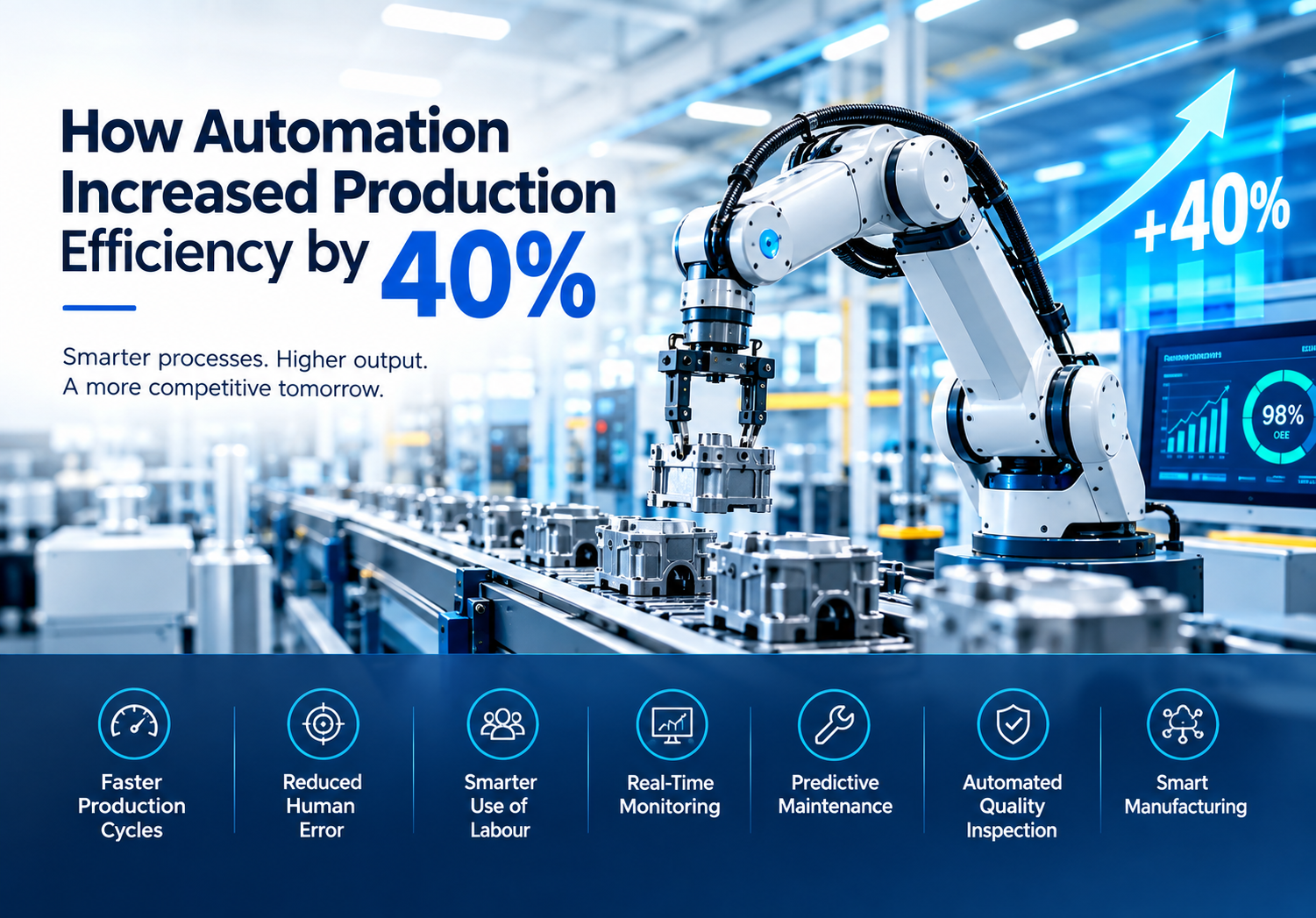
How Automation Increased Production Efficiency by 40%
Manufacturing is entering an era where speed, precision and consistency are no longer optional—they are essential for staying competitive. As manufacturers face rising labour costs, increasing customer expectations and pressure to produce more with fewer resources, industrial automation has become a powerful solution.
In many manufacturing environments, automation can deliver significant improvements in production efficiency, with gains of up to 40% possible when automation is combined with optimized processes, real-time data and smart manufacturing technologies.
But how does automation create such a dramatic improvement?
1. Faster Production Cycles
Automated machines and robotic systems can perform repetitive operations continuously with consistent speed.
Unlike manual processes, automated systems can operate with minimal interruptions, helping manufacturers:
- Increase production output
- Reduce cycle times
- Maintain consistent operating speeds
- Support continuous production
This allows factories to produce more within the same production window without simply adding more manpower.
2. Reduced Human Error
Even highly skilled operators can experience fatigue or inconsistency during repetitive tasks.
Automation helps improve production accuracy and process consistency by executing programmed operations precisely. Applications such as robotic assembly, automated inspection and machine vision can reduce errors while maintaining consistent quality.
The result is fewer defective products, less rework and better utilisation of raw materials.
3. Smarter Use of Labour
Automation does not simply mean replacing manual workers. Instead, it can shift employees from repetitive activities toward higher-value tasks such as supervision, maintenance, programming, quality management and process optimisation.
For manufacturers, this creates a more productive workforce while allowing employees to focus on activities that require human judgement and expertise.
4. Real-Time Production Monitoring
Modern automation systems can collect and analyse production data in real time.
Connected machines, sensors, PLCs, SCADA systems and industrial IoT platforms provide visibility into:
- Machine performance
- Production rates
- Downtime
- Energy consumption
- Quality parameters
- Overall equipment effectiveness
With this information, production teams can identify bottlenecks faster and make data-driven decisions.
5. Predictive Maintenance Reduces Downtime
Unexpected machine breakdowns can bring an entire production line to a halt.
With predictive maintenance, sensors and monitoring systems can detect unusual vibration, temperature, pressure or other performance changes before a major failure occurs.
Instead of reacting after equipment breaks down, manufacturers can schedule maintenance at the right time—helping reduce unplanned downtime and improve equipment availability.
6. Automated Quality Inspection
Quality control is another area where automation can dramatically improve efficiency.
Machine vision systems can inspect components at high speed and identify defects that may be difficult to detect manually. Automated inspection enables manufacturers to check more products without slowing the production line.
This creates a powerful combination of higher throughput and consistent quality.
7. From Automation to Smart Manufacturing
The biggest efficiency gains often come when individual automated machines become part of a connected manufacturing ecosystem.
By integrating robotics, AI, Industrial IoT, machine vision, analytics and digital systems, manufacturers can create smarter production environments where machines, processes and data work together.
This moves factories beyond basic automation toward smart manufacturing and increasingly autonomous production.
A 40% improvement in production efficiency is not simply about installing robots or automated machines. It comes from redesigning processes, connecting equipment, using real-time data and continuously optimizing operations.
For manufacturers looking to increase output, improve quality and reduce downtime, automation provides a pathway toward a faster, smarter and more competitive factory.
The future of manufacturing isn't just automated. It's intelligent, connected and increasingly autonomous.